Delight in the age of AI
Waaay back in 2014, towards the beginning of my design career, I was thinking a lot about delight in product design. Delight was the buzziest of buzzwords at the time. Much like craft and taste are today.
My colleague and friend Ben Tollady even gave a talk on it at UX Australia. Our core idea was simple: there are two kinds of delight:
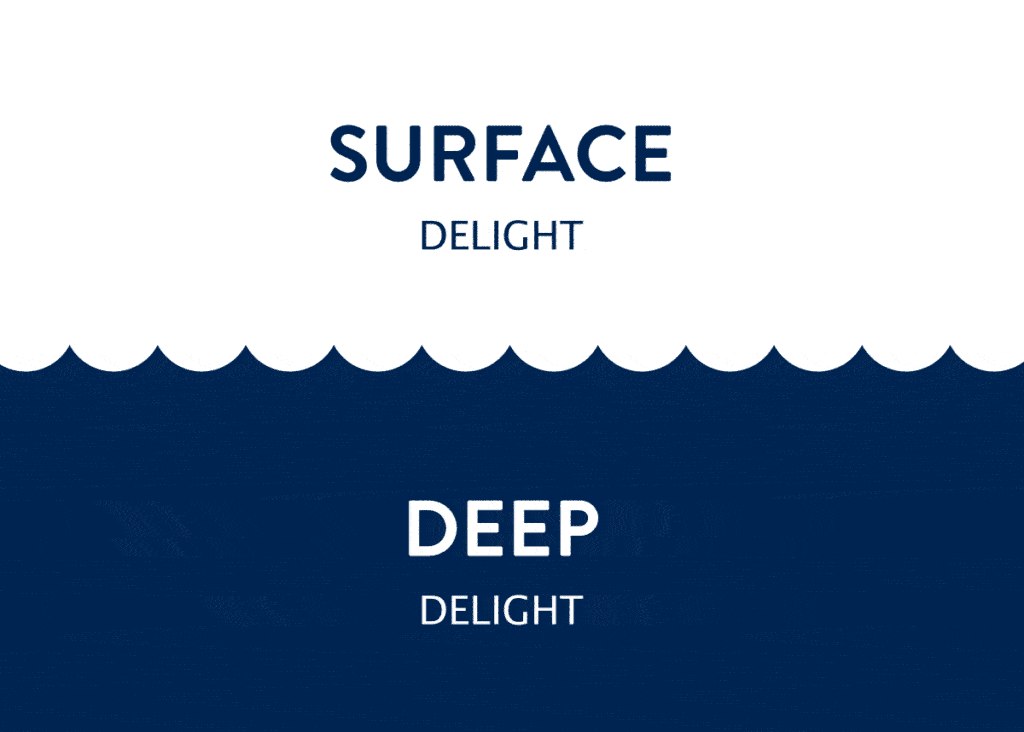
Surface delight - the animations, the miucrocopy, the visual craft; the moments that make something feel good in your hands.
Deep delight - the kind that comes from genuinely understanding a problem, reducing friction, and getting users into a state of flow. The stuff that's invisible when it's working.
Fast forward to 2026, and i think this framing remains relevant - perhaps even more so - with the advent of AI.
Craft. Taste. Polish. Surface Delight.
A lot of the conversation around what makes designers valuable in an AI world focuses on crraft and taste. The argument goes: AI can generate competents interface in seconds, but the texture layer becomes the differentiator for the human.
This is surface delight. And it's having it's moment. Again. Much like it was in 2014. And honestly, it's one of the things that I'm most excited about right now. Those of us who are embracing the vibe-coding moment are creating prototypes, experiments and even apps to showcase our newfound superpowers in creating delightful surfaces.
AI can actually free us up to spend more time on surface craft, not less. Tight budgets and short timelines have always made it tricky to focus on this work. But If the structural work gets faster, we can obsess over the microinteractions, or how a transition feels. Designing with Claude Code, Cursor or any other design tool gives us the superpowers to do this.
Tiny studios like NotBoring are building software that feels like something. Custom animations, haptics, sound design. Incredible attention to detail.
When competence is commoditised, delight is what's left.
Delight goes deeper
But here's what almost nobody is talking about: deep delight.
Deep delight doesn't come from polish. It comes from understanding. From sitting with a problem long enough to see what's actually going on. From research that reveals something you didn't expect. From designing a flow so well that users forget they're using software at all.
The problem is - you can't vibe-code your way to deep delight.
Deep delight requires process. Not the heavy, performative, double-diamond-on-a-whiteboard kind. But the disciplined thinking that helps you understand whether you're even solving the right problem. The kind of process that experienced designers have internalised so deeply it looks like intuition.
When people say "skip the process, just build," they're closing the gap on surface delight while blowing it wide open on deep delight. Without any process, you can move very fast in the wrong direction.
AI has given us an incredible ability to move from idea to reality almost instantly. But it hasn't given us the ability to know whether the idea was right in the first place. That still takes the slow, unglamorous work of understanding people, their problems, and their contexts.
Design needs both
AI is compressing the middle. The functional, reliable, usable layer that used to take most of our time. But both ends of the spectrum are still ours. Surface delight still needs human craft. Deep delight still needs human understanding.
The designers who thrive won't be the ones who move fastest. They'll be the ones who can work at both ends. Those who can obsess over how a button feels and whether the button should exist at all.